Early Childhood Education: 3 Policy Proposals for 2026 to Enhance Access in the US
Anúncios
In 2026, Early Childhood Education (ECE) in the U.S. has reached a “universal threshold,” transitioning from a private luxury to a vital public utility.
With historic federal efforts to bridge the “nanny gap,” new mandates are focusing on three aggressive policy shifts: federally capped tuition, professional wage parity, and the integration of ECE into the public school system.
Anúncios
These proposals aim to boost economic productivity and ensure a child’s zip code no longer dictates their cognitive potential.
The Urgency for Enhanced Early Childhood Education Access
The current state of early childhood education in the US reveals significant disparities, with many families struggling to find affordable and high-quality care.
This lack of access impacts parental workforce participation, child development outcomes, and ultimately, national economic competitiveness.
Research consistently demonstrates the profound benefits of early learning experiences, from improved academic performance to better social-emotional skills and reduced crime rates.
Anúncios
Investing in early childhood education is not merely a social program but a crucial economic strategy.
As such, the push for comprehensive policy reform is gaining momentum, driven by a broad coalition of advocates who recognize the imperative to act now. The proposals for 2026 reflect a concerted effort to overcome existing barriers.
Current Landscape and Challenges
Many states operate with fragmented systems, a mix of public and private providers, and varying standards that lead to an uneven playing field. The cost of childcare often rivals college tuition, making it unattainable for low- and middle-income families.
Furthermore, the early childhood workforce faces low wages, high turnover, and inadequate professional development opportunities.
These factors directly affect the quality of care and education provided to young children, necessitating systemic reforms.
Addressing these multifaceted challenges requires a coordinated approach that tackles affordability, workforce development, and infrastructure.
The forthcoming policy proposals seek to provide such a comprehensive framework for Early Childhood Education: 3 Policy Proposals for 2026 to Enhance Access in the US.
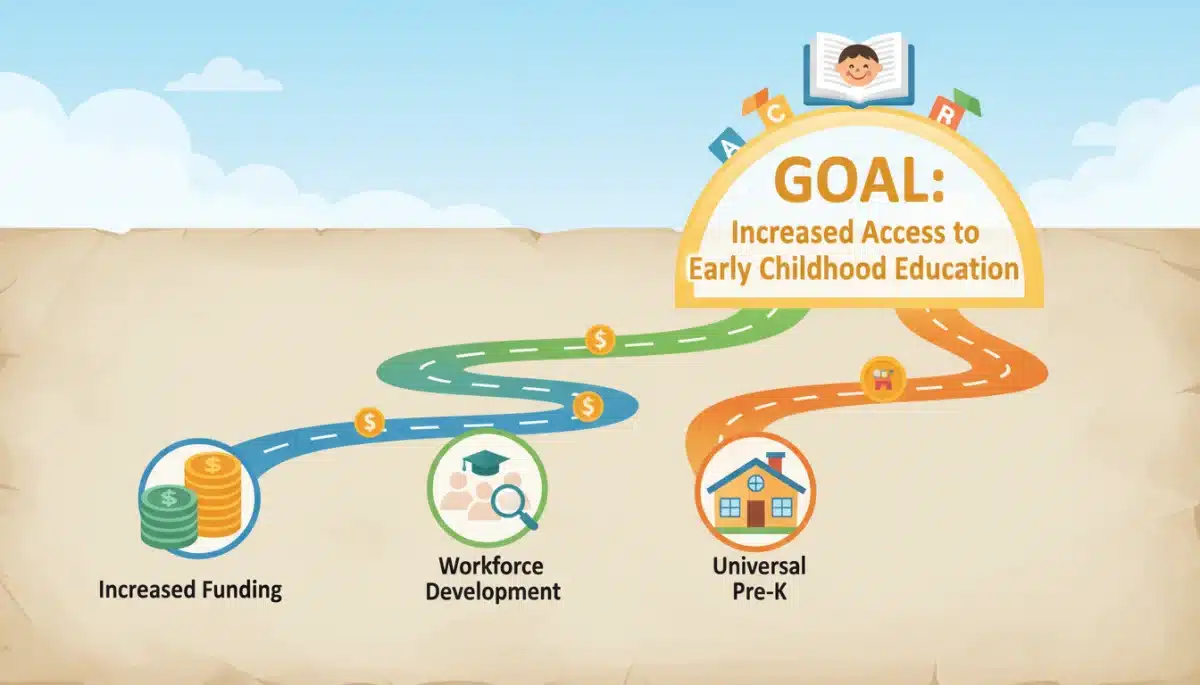
Policy Proposal 1: Universal Pre-Kindergarten Expansion
One of the most ambitious proposals aims to establish universal pre-kindergarten for all four-year-olds across the United States by 2026.
This would significantly expand access to high-quality early learning environments, moving beyond the current patchwork of state and local programs.
The vision is to create a federally supported framework that incentivizes states to develop and implement robust pre-K programs, ensuring consistent quality standards and curriculum.
This initiative seeks to close achievement gaps before children even enter kindergarten.
Such a large-scale expansion would require substantial federal investment, alongside state and local contributions, to build infrastructure, train educators, and sustain operations.
The goal is to make pre-K a standard offering for all families, similar to K-12 education.
Funding Mechanisms and Implementation
Proponents suggest a federal-state partnership model, where the federal government provides significant matching funds to states that commit to universal pre-K.
This would alleviate the financial burden on individual states while ensuring national reach and equity.
- Federal grants to states for program development and expansion.
- Incentives for states to adopt high-quality standards and curricula.
- Targeted support for underserved communities and rural areas.
Implementation would involve a phased approach, starting with states that already have existing pre-K infrastructure and gradually expanding to others.
A key component would be establishing clear benchmarks for quality, including teacher qualifications and classroom ratios, to ensure effectiveness.
Policy Proposal 2: Enhanced Child Care Subsidies and Tax Credits
Recognizing that pre-K alone is not sufficient, a second major proposal focuses on making childcare more affordable for infants, toddlers, and preschoolers not yet in pre-K.
This involves significantly increasing federal subsidies and expanding tax credits for families.
The aim is to cap childcare costs at a reasonable percentage of a family’s income, preventing it from becoming an insurmountable financial barrier.
This would free up household budgets and allow more parents, particularly mothers, to participate fully in the workforce.
These financial interventions are designed to directly reduce out-of-pocket expenses for families, making high-quality care accessible to a broader demographic.
It’s a direct response to the escalating costs that currently burden millions of American households.
Direct Financial Relief for Families
The proposed legislation would expand eligibility for existing childcare assistance programs and introduce new, more generous tax credits.
These measures would apply to a wide range of childcare providers, including centers, family childcare homes, and even some informal arrangements.
- Increased Child and Dependent Care Tax Credit (CDCTC) amounts.
- New federal subsidies tied to income levels, ensuring no family pays more than a certain percentage of income for childcare.
- Streamlined application processes to reduce administrative burdens for families.
By providing direct financial relief, this policy aims to stimulate demand for childcare services, which in turn can support the growth and stability of the childcare sector.
It’s a crucial step in addressing the affordability crisis in Early Childhood Education: 3 Policy Proposals for 2026 to Enhance Access in the US.
Policy Proposal 3: Investing in the Early Childhood Workforce
The success of any early childhood education initiative hinges on a skilled, stable, and well-compensated workforce.
The third critical policy proposal for 2026 focuses on significant investments in recruiting, training, and retaining early childhood educators.
This includes increasing wages to a living wage, providing access to affordable higher education and professional development, and creating clearer career pathways.
Currently, early childhood educators are among the lowest-paid professionals, leading to high turnover and staffing shortages.
Elevating the status and compensation of these professionals is essential for improving the quality of care and education children receive. It acknowledges that the quality of interactions with caregivers directly impacts a child’s development.
Professional Development and Compensation
The proposal advocates for federal grants to states and local programs to increase educator salaries and benefits, bringing them closer to parity with K-12 teachers.
It also includes funding for scholarships and loan forgiveness programs for those pursuing degrees in early childhood education.
- Federal funding for wage supplements and benefit packages.
- Expanded access to higher education and professional certifications.
- Mentorship programs and career ladders to encourage long-term commitment.
By investing in the workforce, these policies aim to create a more attractive and sustainable profession, ensuring that children are cared for by highly qualified and motivated individuals.
This is a foundational element for strengthening Early Childhood Education: 3 Policy Proposals for 2026 to Enhance Access in the US.
Potential Impact on Families and the Economy
The combined effect of these three policy proposals could be transformative for American families.
Increased access to affordable, high-quality early childhood education would alleviate financial stress, boost parental employment, and foster healthier child development.
Economically, studies suggest that every dollar invested in early childhood education yields significant returns in terms of increased tax revenue, reduced welfare dependence, and lower crime rates.
It’s an investment in the nation’s future productivity and social well-being.
These proposals represent a significant step towards creating a more equitable society where all children have the foundation they need to succeed.
The ripple effects would be felt across generations, creating a stronger, more resilient America.
Addressing Equity and Disparities
A core objective of these policies is to reduce the stark disparities in educational outcomes that currently exist based on race, income, and geography.
Universal access and affordability would ensure that children from disadvantaged backgrounds receive the same high-quality opportunities as their more affluent peers.
Targeted funding and resources would be directed towards communities with the greatest needs, ensuring that rural areas and urban centers alike benefit from these expansions.
This focus on equity is paramount to the success of Early Childhood Education: 3 Policy Proposals for 2026 to Enhance Access in the US.
By dismantling financial and systemic barriers, these proposals aim to create a level playing field, giving every child a fair shot at a successful future.
The focus on comprehensive support for families underscores a holistic approach to child development.
Challenges and Implementation Hurdles
While the benefits are clear, implementing such ambitious policies will not be without challenges.
Securing bipartisan support in Congress, navigating state-level political landscapes, and ensuring adequate funding will require sustained effort and collaboration.
Building the necessary infrastructure, including new facilities and a significantly expanded workforce, will also present logistical hurdles.
The demand for qualified early childhood educators would surge, necessitating robust recruitment and training pipelines.
Furthermore, maintaining high-quality standards across a diverse range of providers will require strong oversight and accountability mechanisms. These are not insurmountable obstacles, but they demand careful planning and execution.

Overcoming Political and Logistical Obstacles
Advocates are working to build broad coalitions, highlighting the economic and social benefits to garner political will.
Demonstrating successful pilot programs and showcasing positive outcomes will be crucial in swaying undecided policymakers.
- Securing stable, long-term federal funding commitments.
- Developing flexible state implementation plans that respect local contexts.
- Addressing workforce shortages through innovative training and retention strategies.
The success of these proposals will depend on continuous engagement with stakeholders, adaptability in implementation, and a shared national commitment to prioritizing early childhood development.
The journey to comprehensive reform for Early Childhood Education: 3 Policy Proposals for 2026 to Enhance Access in the US will be complex, but the potential rewards are immense.
The Role of State and Local Governments
While federal initiatives provide a crucial framework and funding, the ultimate success of these policy proposals will depend heavily on the active participation and effective implementation by state and local governments.
States serve as the primary drivers of educational policy and resource allocation.
Each state has unique demographic needs, existing infrastructure, and political priorities that will influence how federal mandates and incentives are translated into actionable programs.
Collaboration between federal, state, and local entities is therefore paramount.
Local communities, including school districts and independent childcare providers, will be on the front lines of delivering these enhanced services.
Their capacity and willingness to adapt will directly impact the reach and quality of early childhood education.
Partnerships and Localized Solutions
States will need to develop comprehensive plans that integrate universal pre-K, expanded subsidies, and workforce development into a cohesive system. This may involve creating new agencies or expanding the roles of existing departments.
- Establishing state-level coordinating councils for early childhood.
- Developing localized strategies to address specific community needs.
- Fostering public-private partnerships to leverage resources and expertise.
The ability of states to innovate and tailor programs to their specific contexts, while adhering to national quality standards, will be a key determinant of success for Early Childhood Education: 3 Policy Proposals for 2026 to Enhance Access in the US.
This localized approach ensures relevance and effectiveness.
Public and Private Sector Collaboration
Achieving the goals set forth by these policy proposals will necessitate robust collaboration between the public and private sectors.
The private childcare industry plays a significant role in the current ecosystem, and its integration into new frameworks is essential.
Government funding and oversight can create a more stable and quality-focused environment, while private providers bring innovation, flexibility, and existing infrastructure.
Finding common ground and fostering mutually beneficial partnerships will be critical.
This collaboration extends beyond direct childcare provision to include businesses that benefit from a skilled workforce and consumer spending, and philanthropic organizations dedicated to child welfare.
A unified front is needed to drive systemic change.
Leveraging Resources and Expertise
Public-private partnerships can facilitate the expansion of facilities, the development of new curricula, and the training of educators.
Businesses can offer support through corporate sponsorships, employee benefits, and advocacy for early childhood initiatives.
- Incentivizing private providers to participate in universal programs.
- Developing shared data systems for tracking outcomes and quality.
- Engaging businesses in advocating for early childhood education policies.
By harnessing the strengths of both sectors, the nation can build a more resilient and comprehensive system for Early Childhood Education: 3 Policy Proposals for 2026 to Enhance Access in the US.
This synergy ensures sustainability and broad impact.
| Key Policy Area | Brief Description of Proposal |
|---|---|
| Universal Pre-K | Federal-state partnership for all 4-year-olds. |
| Child Care Subsidies | Increased federal subsidies & tax credits for families. |
| Workforce Investment | Higher wages, training, and career pathways for educators. |
| Enhanced Access Goals | Reduce disparities, boost parental employment, improve child outcomes. |
Frequently Asked Questions About Early Childhood Education Policies
The main goals are to significantly enhance access to high-quality early childhood education across the US, make childcare more affordable for families, and strengthen the early childhood workforce. These aims collectively seek to improve child development and support parental employment.
Universal pre-kindergarten is proposed to be funded through a federal-state partnership model. The federal government would provide matching funds and incentives to states that commit to establishing and maintaining high-quality pre-K programs for all four-year-olds.
Families will benefit from increased federal subsidies and expanded tax credits, which aim to cap childcare costs at a reasonable percentage of their income. This will directly reduce out-of-pocket expenses, making quality childcare more affordable and accessible for many.
The proposals include significant investments in the early childhood workforce, focusing on increasing wages, providing access to professional development, and creating clear career pathways. The goal is to recruit, train, and retain skilled educators by improving their compensation and professional standing.
Implementation challenges include securing bipartisan political support, navigating diverse state-level priorities, and building the necessary infrastructure and workforce. Ensuring consistent quality standards across various providers will also require robust oversight and adaptability.
Looking Ahead
The proposed policies for Early Childhood Education: 3 Policy Proposals for 2026 to Enhance Access in the US represent a pivotal moment for the nation’s youngest learners and their families.
Their successful implementation promises not only improved educational outcomes but also significant economic and social benefits. Stakeholders must remain engaged, advocating for these changes and ensuring that the momentum for reform continues.
The coming years will be crucial in determining the future trajectory of early learning in America, with profound implications for generations to come.
For those looking to join the next generation of highly skilled educators driving this reform, exploring accredited programmes like the Early Childhood Education Department at SJCC provides the necessary foundation to meet these new professional standards.